Properties Prepared for Immediate Development Use
Land Clearing in Many for overgrown properties requiring complete vegetation removal before construction
Louisiana Forestry Solutions provides land clearing services for residential, agricultural, and commercial properties across Many and surrounding parishes. This service removes trees, brush, stumps, and accumulated debris to create a clean, workable surface ready for construction, farming, or development. The difference between overgrown land and a cleared site becomes immediately visible once heavy equipment completes the removal process and hauls or processes all vegetation.
The work involves cutting and removing standing trees, grinding or extracting stumps below grade, clearing thick brush and undergrowth, and collecting all debris for disposal or processing. Louisiana's dense hardwood growth and clay-heavy soils require equipment specifically suited to handle root systems that extend deep and wide, particularly in bottomland areas where moisture keeps vegetation resilient year-round. The clearing process accounts for drainage patterns to avoid creating low spots that collect water during the region's frequent heavy rain events.
Schedule a property evaluation to identify specific clearing requirements and receive a detailed project estimate.
What Proper Land Clearing Requires
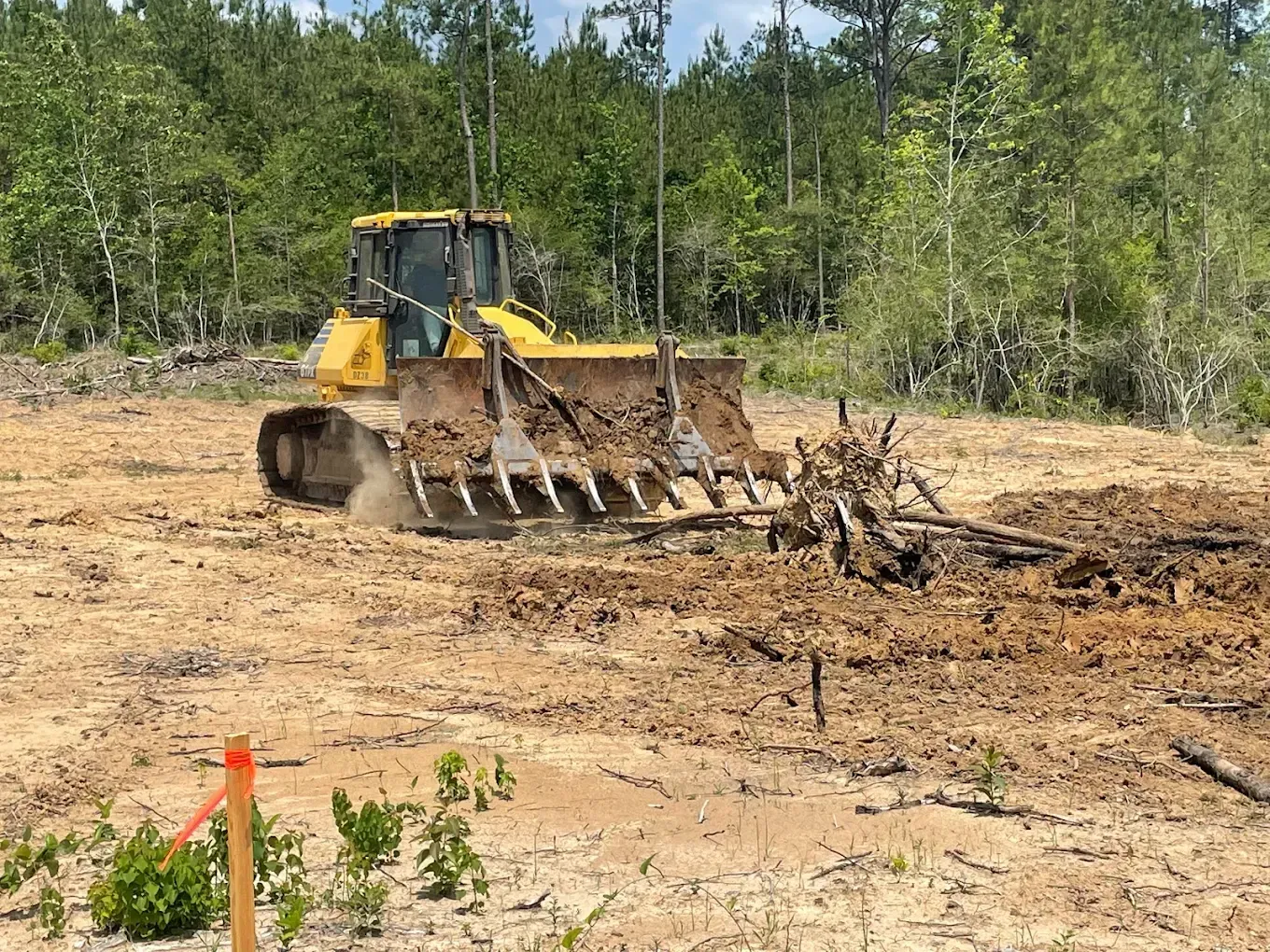
Complete clearing involves more than cutting visible vegetation. The process includes removing root systems that would otherwise sprout new growth, grading the surface to eliminate uneven terrain left by stump removal, and establishing proper drainage flow to prevent standing water. Equipment selection depends on property size, vegetation density, and soil conditions, with tracked machines handling soft or saturated ground better than wheeled units.
After clearing finishes, you'll notice level ground free of obstructions, clear sight lines across the entire property, and a stable surface that supports vehicle traffic without rutting. The land becomes immediately accessible for surveying, foundation work, utility installation, or equipment operation. Debris removal leaves no burn piles or scattered limbs that would delay the next phase of development.
Timing affects project efficiency, as drier months allow equipment to operate without creating deep ruts in saturated soil. Wet season clearing requires additional measures to protect the ground surface and may involve corduroy matting or temporary access roads. The scope of work determines whether debris gets hauled off-site, burned in compliance with local regulations, or processed on-site through grinding.
Questions Before Starting Your Clearing Project
Clearing projects in Many vary based on vegetation type, property size, and intended use, so understanding the process helps set realistic expectations for your timeline and site conditions.
What happens to the debris after clearing?
Debris is either hauled off-site to a disposal facility, burned in compliance with Louisiana Department of Agriculture and Forestry regulations when conditions allow, or ground into mulch depending on your preference and project requirements.
How does Louisiana's clay soil affect stump removal?
Clay soils hold moisture and create dense, compacted conditions around root systems, requiring hydraulic excavators or stump grinders with enough power to break through hardened soil and extract roots cleanly without leaving voids that collapse later.
When is the best time to schedule land clearing?
Late summer through early winter typically offers the driest ground conditions in northwest Louisiana, allowing equipment to operate efficiently without excessive rutting, though projects can proceed year-round with appropriate ground protection measures.
What determines how long a clearing project takes?
Property size, vegetation density, stump count, and debris disposal method all affect duration, with a typical residential lot taking one to three days while larger agricultural or commercial tracts may require a week or more depending on access and soil conditions.
Does clearing improve property drainage?
Removing vegetation and grading the surface allows water to flow more predictably across the land, and experienced operators shape the cleared surface to direct runoff away from structures or toward designated drainage points rather than leaving random low spots.
Louisiana Forestry Solutions coordinates clearing schedules around weather conditions and project deadlines to keep development moving forward. Request a site visit to review your property's specific clearing needs and receive timeline estimates based on current ground conditions.